Conservation Brief

Conservation in India

India holds approximately 75 percent of the world's wild tigers. The following is an overview of the main pressures and the current state of conservation efforts.

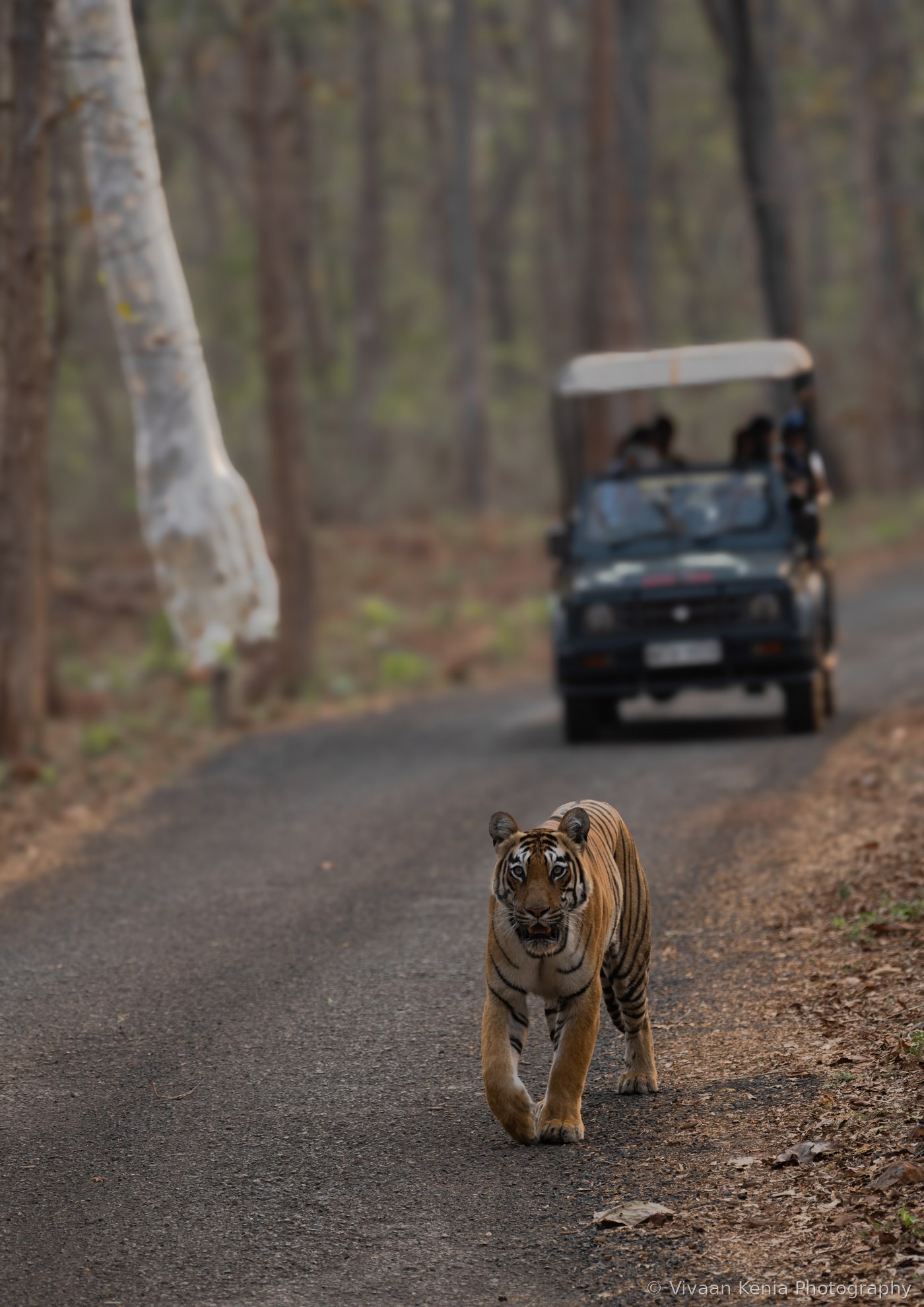
Tiger walking a forest road with a safari vehicle behind, Tadoba-Andhari Tiger Reserve
WildlifeTATR
~3,682
Estimated wild tigers in India (2022 census)
53+
Tiger reserves under Project Tiger
70%
Share of global wild tiger population India holds
18
States with tiger-bearing forest landscapes

Source: National Tiger Conservation Authority (NTCA), All India Tiger Estimation, 2022 cycle. Figures are approximate and updated periodically by the Government of India.

The pressures

Three challenges, playing out at the same time.

Habitat Loss & Fragmentation

Tiger habitats are increasingly broken up by roads, agriculture, mining, and settlements, isolating populations into smaller pockets and cutting off the corridors tigers need to move, disperse, and find mates between reserves.

Human-Wildlife Conflict

As forest and farmland boundaries blur, conflict incidents such as crop damage, livestock loss, and occasionally more serious encounters put real strain on families living closest to tiger habitat, and on their tolerance for conservation.

Poaching & Illegal Wildlife Trade

Despite strong legal protection, poaching for skins, bones, and body parts destined for illegal trade remains a persistent threat, particularly in reserves with limited patrolling capacity or porous boundaries.


India's tiger reserves

53 reserves, one map.

India has 53 designated tiger reserves. Select any marker on the map, or pick a name from the list, to read about that reserve.

Select a reserve on the map or from the list to see details.

All reserves (A–Z)

Marker positions are approximate, based on each reserve's geographic coordinates.


Conservation in context

What the record shows.

Each account below is sourced from published research, government census data, or field records. Click a heading to read it.

In 2006, India's wild tiger population was estimated at 1,411 individuals, based on the first camera-trap All India Tiger Estimation conducted by the NTCA. By 2022, the figure had risen to 3,682. The increase represents more than 160 percent growth over sixteen years, during which India also saw significant economic expansion and urbanisation.

A 2025 study in the journal Science, led by the Wildlife Institute of India, found that tiger-occupied habitat grew by around 30 percent between 2006 and 2018, and that tigers had returned to multi-use landscapes outside protected areas where prey was sufficient and movement corridors remained intact. The study attributed recovery to protective legislation, consistent management, and economic incentives from wildlife tourism in communities near reserves. India holds approximately 75 percent of the world's remaining wild tiger population.

Source: NTCA All India Tiger Estimation 2022; Jhala et al., Science, January 2025.

In 2004 and 2005, tigers disappeared entirely from Sariska Tiger Reserve in Rajasthan. Official records had listed 19. An independent audit confirmed the loss, attributing it primarily to poaching. The government formed the Tiger Task Force under the Prime Minister's Office, which led directly to the creation of the National Tiger Conservation Authority in 2006.

In June 2008, a male tiger from Ranthambhore was airlifted to Sariska by the Indian Air Force. This was described by the NTCA as the first scientifically planned tiger reintroduction in the world. Additional animals were translocated in subsequent years. By 2025, Sariska's count had reached 56. At a national workshop in June 2025, the Union Minister of Environment cited the reserve's recovery as evidence that depleted habitats can be restored through structured intervention and institutional commitment.

Source: NTCA; Ministry of Environment, Forest and Climate Change, June 2025.

Panna Tiger Reserve in Madhya Pradesh lost its last native tiger to poaching by 2008, the second reserve after Sariska to reach complete local extinction. In March 2009, the Madhya Pradesh Forest Department, the Wildlife Institute of India, and the NTCA translocated two tigresses from Bandhavgarh and Kanha, and a male from Pench.

Tigress T1 gave birth to four cubs in April 2010. By 2019, the seven founder animals had produced more than 80 cubs across more than 30 recorded breeding events. Panna was designated a UNESCO Biosphere Reserve in 2020. A 2024 study by Dutta et al. recorded a high survival rate of 0.82 for the reintroduced population, and the reserve is cited in international conservation literature as a reference case for large-carnivore restoration from local extinction.

Source: NTCA; Dutta et al., 2024; UNESCO Biosphere Reserve records.

The hard-ground swamp deer, or barasingha, is found only in India. In 1967, its population in Kanha National Park had fallen to 66 individuals, down from an estimated 551 in 1953. Hunting, habitat loss, and disease had reduced the species to a single viable group.

Kanha's management authority ran a sustained protection and habitat recovery effort over the following five decades. By 2015, the population had reached approximately 450. By 2020, it stood at around 800. In 2023, nineteen barasingha were translocated to Bandhavgarh Tiger Reserve to re-establish the species in part of its former range. The barasingha remains classified as Vulnerable on the IUCN Red List, but the Kanha population is now stable and serves as a source for future reintroduction efforts.

Source: Wildlife Institute of India; IUCN Red List.

The 2025 Science study on India's tiger recovery examined whether tigers could persist in areas with high human populations. The data showed that tiger populations expanded even in areas with average densities of 250 people per square kilometre, provided economic incentives for coexistence existed. Where communities relied heavily on forest resources for subsistence and lacked alternatives, tiger populations declined.

Sawai Madhopur district in Rajasthan, surrounding Ranthambhore National Park, is used in the study as an example where tolerance for large carnivores is relatively high, attributed to wildlife tourism having become part of the local economy. The study's lead researcher, Yadvendradev Jhala of the Wildlife Institute of India, stated that community participation and economic benefit are prerequisites for conservation success in India.

Source: Jhala et al., Science, January 2025.


Related programmes

Tigers of Bharat's community programmes address several of the challenges described above. Further detail is on the Our Work page.